
Awero team
A toe in the door: using virtual reality to open up conversations about work
7 okt., 10:40
For some young people, talking about employment is enough to close down the conversation before it has really begun.
That was one of the first lessons Buzz Bury and the team discovered while delivering virtual reality (VR) work experience through the Loving Work project.
The project was a collaboration with Streetlife, a homelessness charity working with young people aged 16 to 25 in Blackpool, UK. Many of the young people involved were furthest from the employment market, and some had never had a job.
“As soon as we mentioned work,” Buzz explains, “we realised that wasn’t the way to do it.”
So, they changed the invitation.
Instead of asking young people to take part in work-readiness activities, they simply said: “Come and have a go on with the VR headsets.”
That small change mattered. Young people could step into a coffee shop, hairdresser, delivery company, office or other simulated workplace without first having to commit to the idea of getting a job.
For Buzz and the team, this is where VR becomes particularly interesting. It can make work feel less like an intimidating destination and more like something that can be explored.
Let play open the conversation
The VR experiences were deliberately accessible and highly gamified, and that playfulness became part of their appeal.
Some young people came back specifically for the VR, telling the team, “I’ve only come to have a go on that” or “I want to beat my score from last time.”
But behind the scores were opportunities to practise things that matter in the workplaces.
In a delivery simulation, several young people could work for the same virtual company, loading vehicles and trying to get parcels to the right places. When somebody took the wrong route or a delivery went missing, participants had to respond together.
“That’s a bit of strategic planning, and problem solving” Buzz says, “even though it’s all really gamified.”
Similarly, he reflects on seeing two young men who had previously engaged very little, finding themselves working together inside a firefighting simulation. Suddenly they were communicating and calling instructions to one another: “Get the ladders off the back of the truck… there’s a woman in the attic.”
“It was just brilliant to see,” Buzz says.
For youth workers, these moments offer something more valuable than simply completing a game. Communication, teamwork and problem-solving have become visible, and now there’s something real to talk about.
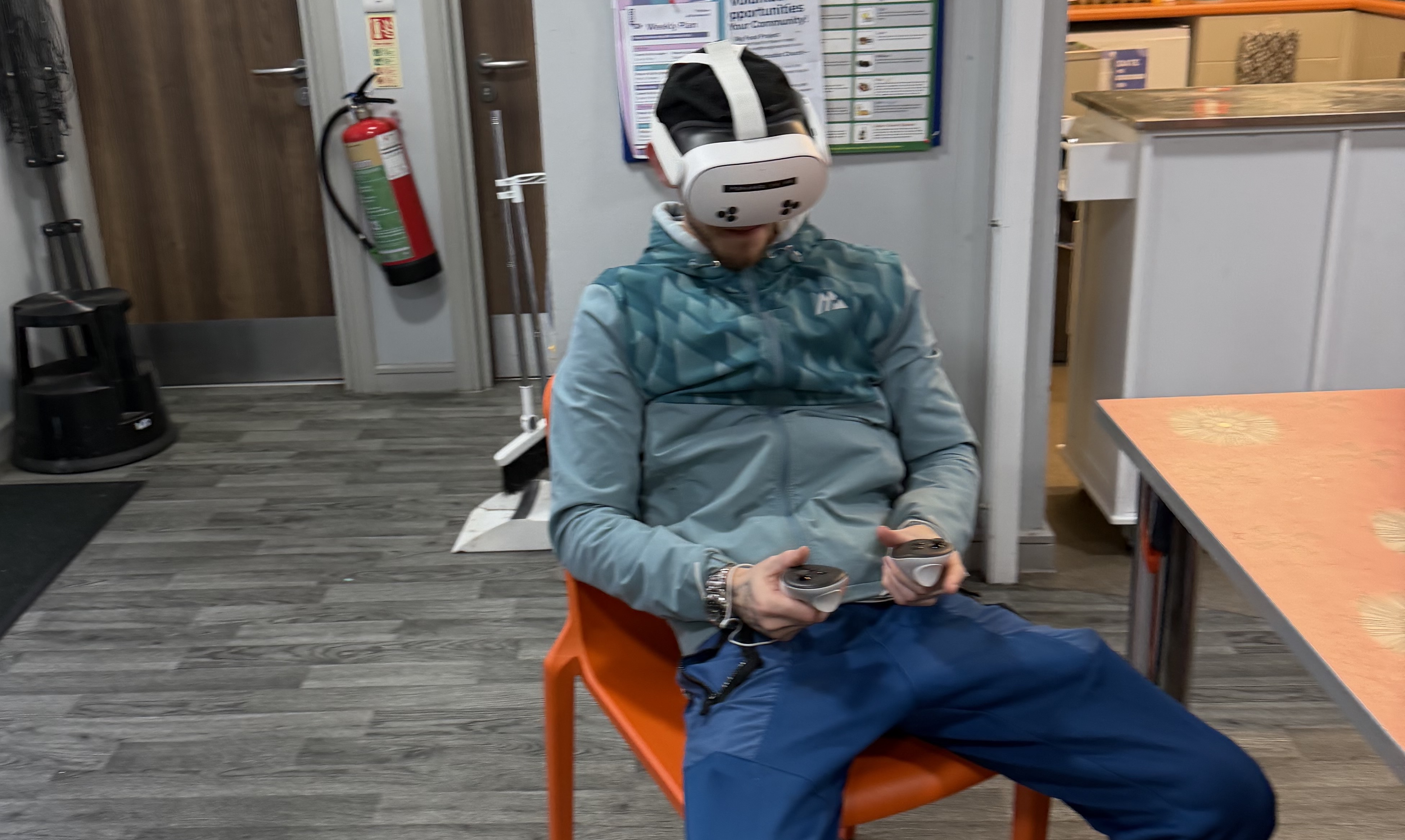
The learning starts when the headset comes off
Those follow-up conversations are central to the approach.
“A lot of the really good work comes after,” Courtney Clowes, VR Project Worker explains.
The VR experience gives young people something concrete to reflect on: What happened? What did you do? What were you good at? What did you find difficult?
“We’re talking about skills, competences, knowledge, experience,” Courtney says. “What are you able to demonstrate and transfer to a job?”
Even very simple simulations can create useful moments.
In one coffee-shop experience, a participant could not progress until they had memorised information from the menu. In a hairdressing simulation, one young person became frustrated because the virtual scissors would not work. The missing ingredient was not technical ability but customer service: the simulation prompted them to make the customer feel welcome.
Asked what they would normally do, the young person replied: “Offer him a brew.” They offered the virtual customer tea or coffee, and the scissors started working.
It is a tiny interaction, but that is precisely the point. A conversation about customer service no longer needs to begin with a definition. It can begin with something the young person has just experienced.
For Buzz, these reflections can then extend towards CVs and interviews: “How could you include this experience you’ve had on a CV?”
VR creates the situation. Youth work turns that situation into recognised learning and supporting the young person to realise their potential.
Seeing jobs they hadn’t imagined
VR also gave participants glimpses into work they might otherwise never have considered.
One young person was already interested in joining the army. The available military simulation, however, was focused on logistics - moving resources and getting the right containers and equipment to the right places.
It prompted a different thought: “I don’t need to work on the front line… there’s other jobs within the military that I’ve just not thought about.”
Delivery simulations sparked similar conversations. Buzz remembers young people saying, “Now I want to get my licence. I could go and work for Amazon.”
The VR experience may not have led young people directly to employment but what they did see was something smaller, but potentially significant: “It just triggers that little interest or spark,” Buzz explains.
For young people who may never have worked, or who find employment difficult even to imagine, that spark can be a meaningful starting point.
It starts a conversation, that is led by the young person, that otherwise would not happen. They can discuss what they enjoyed and what they excelled at and find something in the real world that aligns with it. The conversation becomes exciting, the prospect of doing something they now know they enjoy is a lot less daunting.
One participant summed up the problem particularly clearly. Employers ask, “Have you got any experience?” But, as the young person told Buzz, “You say, ‘No’, because you don’t have any experience, and you don’t know how you get it.”
As a result of the project young people said they could imagine giving a different answer: “I have got some experience, but it was through VR.”
Facilitation key to success with technology
None of this means putting on a headset automatically produces meaningful learning.
The project encountered plenty of practical challenges. Free applications did not always save progress on shared headsets. Different programmes used different controls. Some people experienced motion sickness. Without a dedicated VR space, the team often encouraged participants to remain seated.
There was also the vulnerability of trying something unfamiliar in front of other people. A young person wearing a headset could hear others laughing without knowing what they were laughing at. Screen-sharing the VR view onto a computer or phone helped enormously because everyone else could see what was happening.
Buzz also stresses that facilitators need to be familiar with the technology too to get the most out of it, particularly when controls and environments differ between applications.
“You need to have that experience yourself to know what you’re talking about,” Buzz explains.
Buzz is clear, VR is not a ready-made work-readiness programme or a replacement for other methods. It is one way to start a conversation.
“It could be one way of possibly connecting with some of the most hard to reach young people,” he says.
For those young people, a playful 45 minutes in a virtual coffee shop, delivery van or workplace might be enough to make an unfamiliar future feel slightly more imaginable.
And sometimes work readiness begins there: not with an application form, a CV or a meeting about employability, but with curiosity, a shared experience. As Buzz puts it, it's “a little toe in the door.”
To find practical tools, guidelines and resources created through the project visit the Cities of Learning Virtual Reality platform.

Funded by the European Union. Views and opinions expressed are however those of the author(s) only and do not necessarily reflect those of the European Union or the European Education and Culture Executive Agency (EACEA). Neither the European Union nor EACEA can be held responsible for them.
Delen: